
Ruth Ellen® Flowering Dogwood
Cornus 'Rutlan'



Height: 18 feet
Spread: 20 feet
Sunlight:


Hardiness Zone: 5a
Other Names: Cornus florida x kousa
Group/Class: Rutgers Stellar Series
Description:
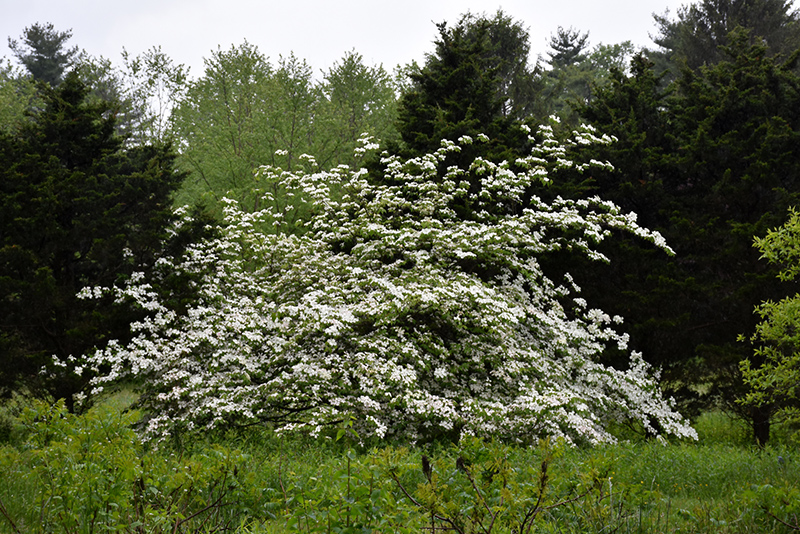
An interesting hybrid featuring a heavy floral display of near-white blooms; more resistance to borers and disease than older varieties; this dogwood tends to have a low branching, spreading habit; a spectacular landscape accent tree
Ornamental Features
Ruth Ellen® Flowering Dogwood is bathed in stunning clusters of white flowers with creamy white overtones held atop the branches in late spring. The "flowers" are actually comprised of a showy ring of colored bracts (modified leaf structures) surrounding the true chartreuse inflorescence in the center. It has attractive yellow-tipped green foliage. The pointy leaves are highly ornamental and turn an outstanding plum purple in the fall. The peeling gray bark and antique red branches are extremely showy and add significant winter interest.
Landscape Attributes
Ruth Ellen® Flowering Dogwood is a multi-stemmed deciduous tree with a stunning habit of growth which features almost oriental horizontally-tiered branches. Its average texture blends into the landscape, but can be balanced by one or two finer or coarser trees or shrubs for an effective composition.
This is a relatively low maintenance tree, and should only be pruned after flowering to avoid removing any of the current season's flowers. It is a good choice for attracting birds to your yard. It has no significant negative characteristics.
Ruth Ellen® Flowering Dogwood is recommended for the following landscape applications;
- Accent
- Shade
Planting & Growing
Ruth Ellen® Flowering Dogwood will grow to be about 18 feet tall at maturity, with a spread of 20 feet. It has a low canopy with a typical clearance of 2 feet from the ground, and is suitable for planting under power lines. It grows at a slow rate, and under ideal conditions can be expected to live for 40 years or more.
This tree does best in full sun to partial shade. It does best in average to evenly moist conditions, but will not tolerate standing water. This plant should be periodically fertilized throughout the active growing season with a specially-formulated acidic fertilizer. It is very fussy about its soil conditions and must have rich, acidic soils to ensure success, and is subject to chlorosis (yellowing) of the foliage in alkaline soils. It is somewhat tolerant of urban pollution, and will benefit from being planted in a relatively sheltered location. Consider applying a thick mulch around the root zone in winter to protect it in exposed locations or colder microclimates. This particular variety is an interspecific hybrid.